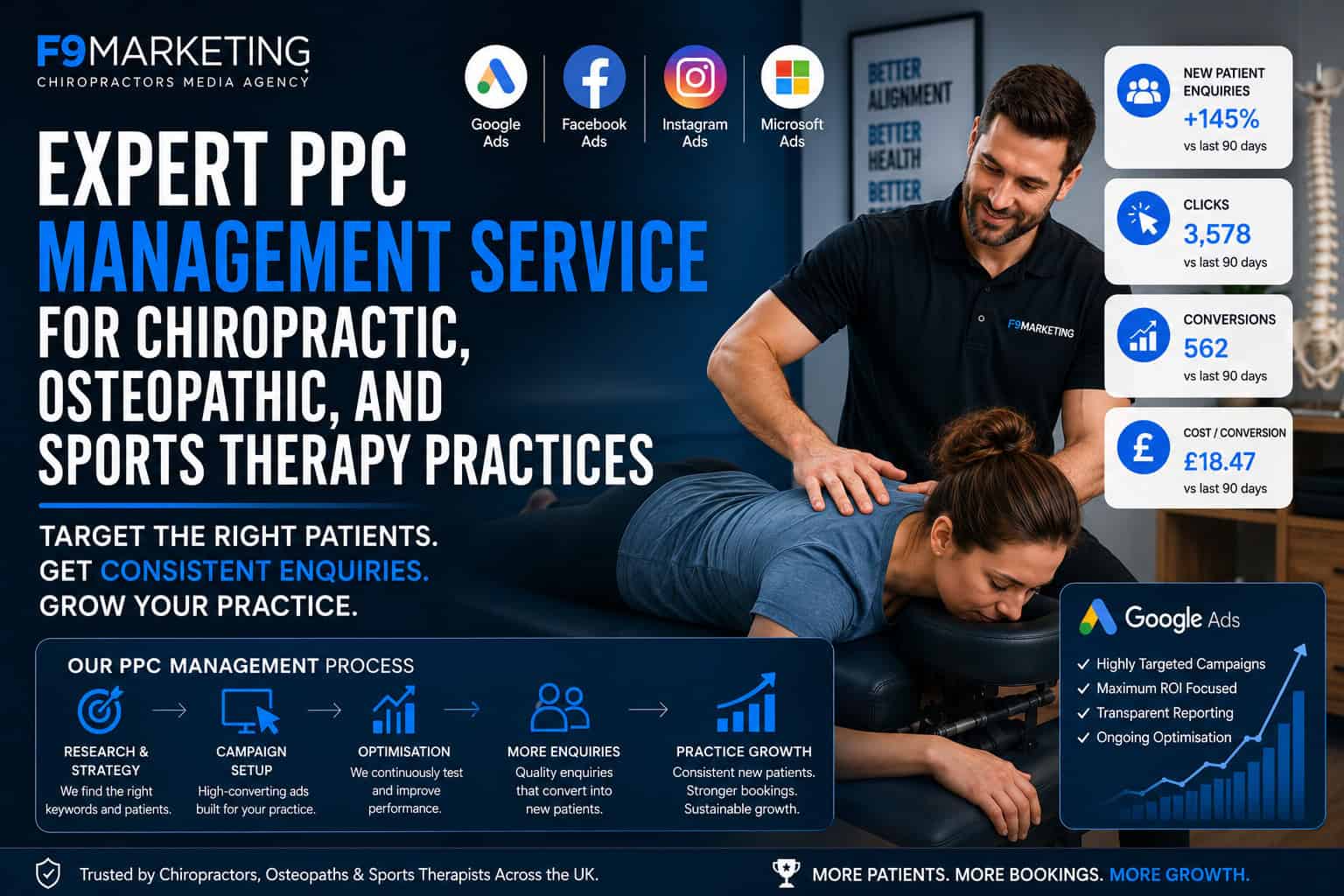
Most private healthcare practices do not struggle because demand is missing. They struggle because patient acquisition is inconsistent. Some weeks the appointment book is full. Other weeks there are unexpected gaps that create financial pressure and operational uncertainty.
This is one reason PPC advertising remains a widely used acquisition channel for chiropractic, osteopathic, and sports therapy clinics. Search advertising places a practice directly in front of patients already looking for treatment. Unlike long-term channels such as SEO or referral development, PPC can generate enquiries almost immediately.
But running ads is not the same thing as running profitable campaigns.
Many practices spend heavily on Google Ads while seeing weak patient quality, poor retention, and rising acquisition costs. The issue is rarely the advertising platform itself. More often, campaigns fail because the management strategy behind them is shallow.
An expert PPC management service is not simply about launching ads. It involves controlling economics, improving conversion efficiency, refining targeting, and measuring profitability at every stage of the patient journey.
Why PPC Matters for Patient Acquisition
Healthcare search behaviour is different from many other industries because patient intent is usually immediate.
Someone searching for “sports injury treatment,” “chiropractor for sciatica,” or “osteopath for back pain” is actively looking for help rather than casually browsing. This creates an environment where properly managed PPC campaigns can convert at relatively high rates compared to broader awareness advertising.
The advantage is timing.
PPC allows practices to appear at the exact moment discomfort, urgency, or pain motivates someone to seek treatment. This reduces the gap between search intent and appointment booking.
Organic SEO still matters, but competitive healthcare keywords often take six to twelve months to rank meaningfully. PPC compresses that timeline dramatically.
According to healthcare PPC benchmark studies, well-structured search campaigns commonly achieve landing page conversion rates between 10% and 20% depending on competition, geography, and service type.
Source:
https://theleadingpractice.com/blog/chiropractic-google-ads-benchmarks-2026/
What an Expert PPC Management Service Actually Includes
Keyword Intent Analysis
One of the biggest differences between average and expert PPC management is keyword selection.
Many campaigns fail because they target broad informational traffic instead of treatment-focused searches.
For example:
- “What causes lower back pain” may generate traffic but weak booking intent
- “Chiropractor for lower back pain near me” usually reflects stronger patient intent
Expert campaign management focuses on identifying commercial healthcare searches tied directly to appointment behaviour.
This generally involves:
- Condition-based keywords
- Treatment-specific searches
- Location-intent phrases
- Urgency-driven searches
- Mobile-first patient behaviour
The goal is not maximum traffic volume. The goal is profitable patient acquisition.
Landing Page Alignment
Traffic quality alone is not enough.
One of the most common PPC mistakes in healthcare marketing is sending ad traffic to a generic homepage.
A homepage tries to explain an entire practice. PPC visitors usually want answers to a very specific problem.
Someone searching for “sciatica treatment chiropractor” should land on a page focused specifically on sciatica.
High-converting healthcare landing pages usually contain:
- Clear treatment relevance
- Simple booking pathways
- Mobile-friendly layouts
- Visible trust indicators
- Direct practitioner positioning
- Clear call-to-action structure
Conversion optimisation is often more financially impactful than simply increasing ad spend.
For example, improving a landing page conversion rate from 6% to 12% effectively halves lead cost without increasing traffic.
Negative Keyword Management
Not every click has value.
Without ongoing search term refinement, healthcare PPC campaigns often waste significant budget on irrelevant searches.
Common examples include:
- Training courses
- Salary searches
- Free advice queries
- Insurance-only searches
- DIY treatment research
Expert PPC management continuously removes low-quality traffic through negative keyword optimisation.
This process improves:
- Click quality
- Conversion rates
- Budget efficiency
- Lead quality
Geographic Bid Control
Most chiropractic, osteopathic, and sports therapy patients travel within a relatively limited geographic radius.
That makes geographic targeting extremely important.
Expert campaign management typically includes:
- Radius targeting
- Location exclusions
- Bid adjustments by postcode
- Distance-based optimisation
- Mobile proximity targeting
This prevents wasted spend on patients unlikely to travel for treatment.
The Economic Reality Behind PPC Campaigns
PPC campaigns should never be judged purely on click cost.
The important question is whether acquired patients generate sustainable long-term value.
Understanding Patient Lifetime Value
Example:
- Initial consultation: £85
- Average treatment plan: 5 sessions
- Total average care value: £425
- Additional retention services: £175
- Estimated patient lifetime value: £600
This number determines how aggressively a practice can acquire patients profitably.
Calculating Acceptable Acquisition Costs
Many healthcare practices target patient acquisition costs between 15% and 35% of lifetime value.
Using the previous example:
- £600 lifetime value
- Acceptable patient acquisition cost: approximately £90–£210
This is why focusing only on cost per click creates misleading conclusions.
A higher click cost can still produce stronger profitability if patient quality and retention are better.
Why Conversion Rates Matter More Than Traffic Volume
Traffic alone does not produce revenue.
The real financial leverage comes from improving conversion efficiency throughout the patient journey.
For example:
- Landing page conversion rate: 10%
- Lead-to-booking rate: 60%
- Show-up rate: 85%
- Treatment plan acceptance rate: 70%
Small improvements at each stage compound significantly.
This is why expert PPC management focuses heavily on operational performance rather than just ad creation.
Advantages of an Expert PPC Management Service
Faster Optimisation Cycles
PPC platforms reward data-driven optimisation.
Experienced management improves campaign performance more quickly because patterns are identified earlier:
- Weak keywords removed faster
- High-converting search terms prioritised sooner
- Poor-performing locations excluded earlier
- Budget reallocated more efficiently
This reduces wasted spend during the learning phase.
Better Budget Allocation
Many healthcare campaigns waste money by spreading budget too broadly.
Expert management usually prioritises:
- High-intent searches first
- Strong-performing services
- Geographic areas with proven conversion rates
- Appointment-ready patient traffic
Disciplined budget allocation generally outperforms aggressive scaling strategies.
More Accurate Attribution
Healthcare patients often convert through phone calls rather than forms.
Without proper call tracking, campaign reporting becomes incomplete.
Expert PPC management typically includes:
- Phone call tracking
- Lead source attribution
- Appointment tracking
- Revenue attribution
- Conversion path analysis
Better attribution improves optimisation decisions over time.
Common PPC Management Mistakes
Using Broad Match Keywords Without Control
Broad match targeting can generate large amounts of irrelevant traffic if unmanaged.
This usually increases:
- Wasted spend
- Poor-quality leads
- Low conversion rates
Healthcare campaigns require close query monitoring.
Scaling Too Quickly
Many practices increase budgets aggressively before campaigns stabilise.
This often creates:
- Higher acquisition costs
- Reduced lead quality
- Inconsistent performance
Most campaigns require several months of refinement before predictable scaling becomes realistic.
Ignoring Front Desk Performance
PPC performance depends heavily on operational follow-up.
Strong campaigns can still fail because of:
- Missed calls
- Slow responses
- Weak booking scripts
- Poor appointment reminders
Advertising quality cannot compensate for broken lead handling systems.
Realistic Timelines for PPC Campaign Performance
Month 1
- Keyword testing
- Data collection
- Baseline conversion measurement
- Initial search term refinement
Performance is often unstable during this phase.
Months 2–3
- Improved targeting accuracy
- Negative keyword expansion
- Landing page refinement
- Better lead quality trends
Months 4–6
- More predictable acquisition costs
- Improved conversion consistency
- Stronger quality scores
- Clearer ROI visibility
Months 6–12
- Scalable campaign structure
- Service segmentation
- Location refinement
- Long-term profitability optimisation
Practices expecting fully optimised PPC economics within a few weeks usually underestimate the refinement process required.
When PPC Management Does Not Work Well
Very Small Budgets in Competitive Markets
Healthcare PPC costs can be substantial in competitive areas.
Very small budgets often produce insufficient data for meaningful optimisation.
Weak Patient Retention
If patient lifetime value is too low, paid acquisition becomes difficult to sustain profitably.
Retention and treatment adherence directly affect marketing economics.
Lack of Service Differentiation
Generic positioning tends to reduce PPC performance.
Specific positioning often converts better:
- Sports injury rehabilitation
- Pregnancy-related care
- Sciatica treatment
- Postural correction
- Runner recovery programs
Measurement Frameworks That Matter
| Metric |
Why It Matters |
| Cost Per Lead |
Measures enquiry efficiency |
| Cost Per Appointment |
Reflects booking quality |
| Show Rate |
Measures operational effectiveness |
| Patient Acquisition Cost |
Core profitability benchmark |
| Lifetime Value |
Determines sustainable scaling |
| Landing Page Conversion Rate |
Indicates message alignment quality |
Practical Starting Point for PPC Campaigns
Start Narrow
Most practices benefit from starting with:
- One core treatment category
- One focused geographic area
- One dedicated landing page
This creates cleaner data and easier optimisation.
Prioritise Conversion Tracking Early
Proper tracking should include:
- Phone calls
- Form submissions
- Appointment bookings
- Lead source attribution
Without accurate tracking, campaign decisions become unreliable.
Review Search Terms Weekly
Search term refinement remains one of the highest-impact optimisation activities in healthcare PPC management.
Final Thoughts
An expert PPC management service is not simply about generating more clicks or increasing traffic volume.
The real objective is profitable patient acquisition supported by sustainable economics.
The strongest campaigns usually succeed because they combine:
- High-intent targeting
- Conversion-focused landing pages
- Accurate tracking systems
- Fast operational follow-up
- Clear patient lifetime value understanding
PPC can become one of the most predictable patient acquisition channels available to chiropractic, osteopathic, and sports therapy practices.
But profitability depends far more on strategic management discipline than advertising spend alone.
Ready to grow your business? Contact us for a free initial consultation to find out if we're a good fit.