TL;DR — Key Takeaways on investing in SEO for better visibility.
- Core argument: Implementing a successful healthcare SEO strategy is essential for visibility in the medical industry. SEO for healthcare providers is not a single tactic — it is a layered system of technical foundations, local search signals, clinical content authority, and reputation management SEO is not a single tactic — it is a layered system of technical foundations, local search signals, clinical content authority, and reputation management. Google applies its highest scrutiny standards to healthcare under its YMYL (Your Money or Your Life) framework. Practices that handle this correctly build an organic visibility asset that generates new patients at near-zero ongoing cost. Those who cut corners lose rankings faster than in almost any other sector.
- Click economics: The top 3 organic results collectively receive 68.7% of all clicks on a Google results page. Position 1 alone draws 28.5% of clicks. For local-intent healthcare searches, the Google 3-Pack (map pack) captures 44% of all clicks on local results pages — before organic listings even appear (First Page Sage, 2025; SeoProfy / RedLocalSEO, 2026), highlighting the importance of healthcare SEO services.
- The local 3-Pack is disproportionately valuable: Businesses in the Google 3-Pack receive 126% more traffic and 93% more actions — calls, clicks, direction requests — compared to those ranked 4th–10th. Businesses with consistent NAP (Name, Address, Phone) data across healthcare directories are 40% more likely to appear in the local pack (SeoProfy, 2026; BrightLocal, 2025).
- YMYL and E-E-A-T are critical components of a successful healthcare SEO strategy. Google’s December 2025 Core Update hit Health/YMYL sites hardest, with 67% of affected sites experiencing ranking drops in search engine results. Recovery takes 2–6 months for most sites and 6–12 months for YMYL, depending on the effectiveness of their SEO efforts. Practices with named practitioner credentials, evidence-based content, and clinical authorship signals are systematically more resistant to algorithm volatility (ALM Corp analysis of December 2025 Core Update).
- Realistic timelines: Google Business Profile / local pack: 3–6 months for competitive visibility. Condition-specific on-site content: 6–12 months for page-one rankings. Link authority and domain prominence: 9–18 months to produce meaningful compounding effect.
- Economic framework: Conservative healthcare patients carry an LTV of £800–£2,500, making them valuable in the healthcare industry. Search engine optimization generates patient enquiries at near-zero marginal cost once rankings are established. A practice appearing in the top 3 for 4–6 high-intent local search terms can realistically generate 4–8 new patient enquiries per month from organic search alone, with no ongoing ad spend required.
- The single most-neglected improvement: Dedicated condition-specific service pages are best practices for improving online visibility in healthcare services. Most chiropractic and osteopathic websites use a single ‘Services’ page covering 8–15 conditions. Google cannot rank one page effectively for multiple distinct search intents. A dedicated page for sciatica, one for back pain, one for sports injuries, and so on is the highest-leverage structural SEO change available to most practices — and the most consistently overlooked.
- AI search and the local pack: 40.2% of local business queries now trigger Google’s AI Overviews (LocalFalcon / SeoProfy, 2026). AI search draws from the same foundations as traditional local SEO: GBP completeness, reviews, citations, and structured content. There is no separate ‘AI SEO strategy’ — there is only rigorous local SEO done consistently.
|
Why SEO for Healthcare Providers Operates Under Different Rules
Approximately 77% of patients use a search engine before booking a healthcare provider (Demandforce, 2026). That figure alone would make SEO a priority for any private practice. But healthcare SEO is not simply general SEO applied to a clinical context. Google evaluates healthcare websites under a framework that is structurally stricter than almost every other category, and the practices that understand this distinction invest their effort correctly and hold their rankings over time.

The reason is Google’s YMYL classification — Your Money or Your Life. Healthcare content, Google reasons, can directly affect a person’s physical wellbeing. A patient who acts on inaccurate or misleading information from a poorly substantiated website risks real harm. Google responds by applying its highest quality evaluation standards: requiring demonstrated expertise, verifiable practitioner credentials, evidence-based claims, and website infrastructure that justifies patient trust. These requirements have been progressively tightened with every major core update. Google’s December 2025 Core Update hit Health/YMYL sites harder than any other category, with 67% of affected medical practices recording ranking drops (ALM Corp analysis, December 2025). Recovery for YMYL sites takes 6–12 months — twice the typical timeline for non-healthcare content.
The consequential insight for conservative healthcare practices is this: these stricter standards are a competitive advantage, not a burden. A chiropractic or osteopathic practice whose website demonstrates genuine clinical expertise, named practitioner credentials, and a well-maintained local presence is structurally difficult for competitors to outrank. The practices that do SEO properly in a YMYL context build a durable position. Those that publish anonymous content, use templated service descriptions, or neglect their Google Business Profile lose ground with every algorithm cycle and do not easily recover.
The economic case is equally clear. Organic SEO, once established, generates patient enquiries at near-zero marginal cost. Unlike paid search — which stops delivering the moment the budget stops — organic rankings earned through disciplined effort continue producing traffic indefinitely. The investment is front-loaded across an initial 6–12 months of sustained activity, but the return compounds. A practice ranking in positions 1–3 for its primary condition-and-location terms will still be generating patient enquiries from that investment in three years’ time without any additional media spend.
Google Business Profile: The Highest-Return Local SEO Asset
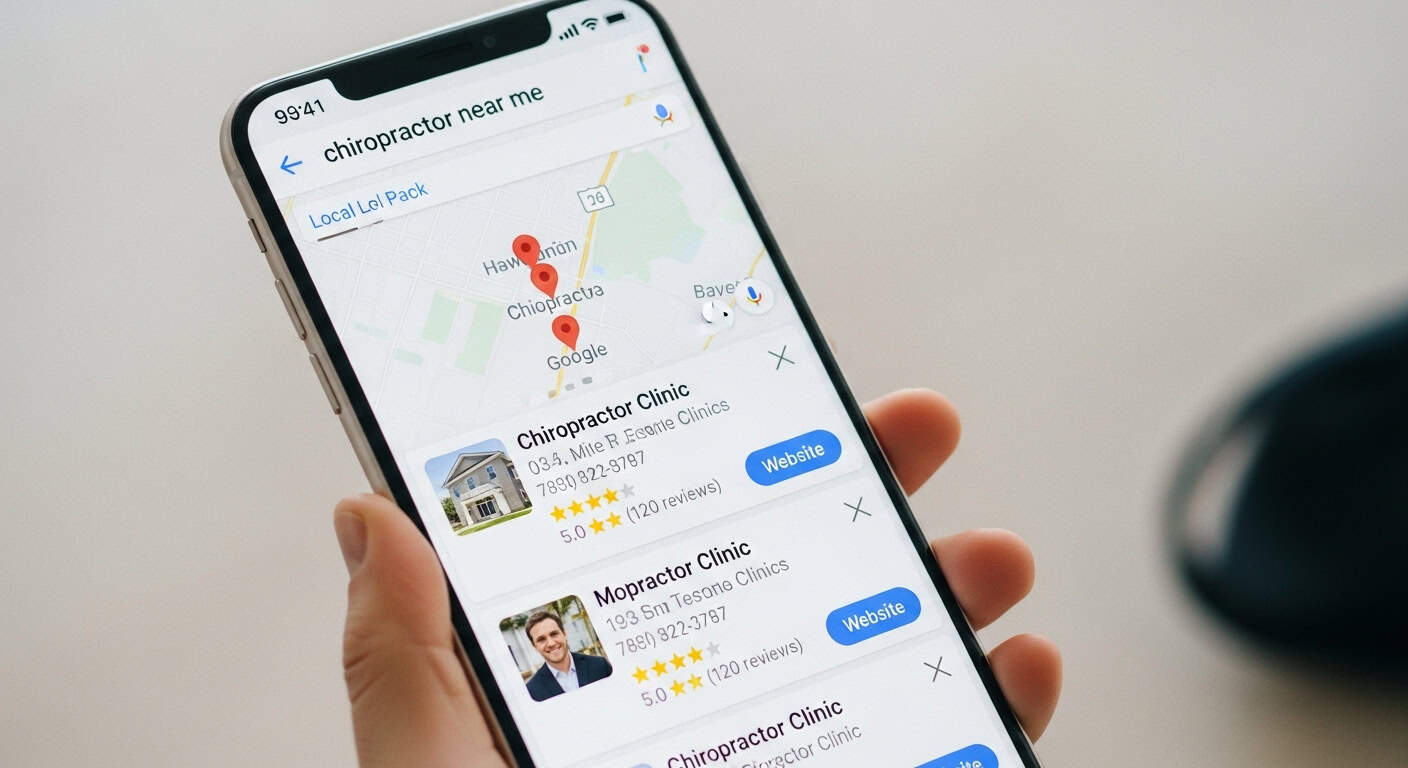
For a single-location chiropractic, osteopathic, or sports therapy practice, Google Business Profile (GBP) is the most important digital asset in the entire SEO system. It is not the most glamorous — it is the most consequential. GBP signals govern performance in the Google 3-Pack: the three prominently displayed local business listings that appear at the top of results for local-intent queries, ahead of all organic website results on mobile.
The click concentration in the 3-Pack is significant. Businesses appearing there receive 126% more traffic and 93% more actions — calls, direction requests, website clicks — than businesses ranked between 4th and 10th (SeoProfy, 2026). The local pack as a whole captures 44% of all clicks on a local search results page (RedLocalSEO / SeoProfy, 2026). For a patient searching ‘chiropractor near me’ on a mobile phone, the 3-Pack is often the only result visible without scrolling. Position matters within it: the first listing receives the majority of clicks, with second and third receiving progressively fewer.
| Businesses in the Google 3-Pack receive 126% more traffic and 93% more actions than those ranked 4th–10th. The local map pack captures 44% of all clicks on local results pages, significantly impacting search engine results. Businesses with consistent NAP data across major citation sources are 40% more likely to appear in the local pack, which is vital for on-page SEO.
Source: SeoProfy, 2026; BrightLocal Local Search Ranking Factors, 2025; utilizing healthcare SEO services can enhance visibility. |
Google evaluates GBP profiles on three axes: Relevance (how well the profile matches the search query), Distance (proximity to the searcher), and Prominence (how well-known and trusted the business appears based on available signals). Of these three, Prominence is the most directly improvable through deliberate action, and it is where most practices have the most ground to gain.
Building a Fully Optimised GBP
A fully optimised GBP for a conservative healthcare practice means: the correct primary category (Chiropractor, Osteopath, or Sports Medicine Clinic as appropriate) with relevant secondary categories added; a complete service list with individual descriptions of 100–150 words for each condition or treatment offered; at least 10–15 high-quality photographs of the clinic interior, exterior, and practitioners; weekly GBP posts covering educational content, clinic news, or patient guidance; and a consistently growing volume of recent Google reviews.
The service descriptions within GBP are among the most consistently underused optimisation opportunities available to a small practice. Most list a service name with no further detail. A service description for ‘Sciatica Treatment’ that explains what sciatica is, how chiropractic or osteopathic intervention addresses it, and what a treatment course typically involves gives Google the contextual signals to surface the profile for condition-specific searches — not just generic ‘chiropractor near me’ queries. This single change alone can meaningfully expand the range of search terms a profile appears for without any technical work on the website, aligning with common SEO practices.
GBP and the AI Search Landscape
40.2% of local business queries now trigger Google’s AI Overviews (LocalFalcon / SeoProfy, 2026). AI search draws from the same data sources as traditional local SEO: GBP completeness, reviews, citations, and structured content on the practice website. Clinics with detailed, accurate GBP profiles, strong review profiles, and locally relevant website content are the ones appearing in AI-generated local responses. There is no separate strategy required for AI search — the same foundational work that improves traditional local rankings simultaneously improves AI search visibility.
On-Site SEO Architecture: The Structural Decisions That Determine What Can Be Ranked
A Google Business Profile drives map pack visibility, essential for attracting patients searching for medical information. The practice website drives organic listing rankings and — once a patient clicks through — the conversion from visitor to enquiry. Both assets need to work together. A polished GBP that clicks through to a slow, poorly organised website loses patients at the point of highest interest. And a strong website with a neglected GBP misses the patients who never get past the 3-Pack.
Dedicated Service Pages: The Single Highest-Leverage Structural Change
The most consequential on-site SEO improvement available to most conservative healthcare practices is replacing a single consolidated ‘Services’ page with dedicated, condition-specific pages. Google’s algorithm evaluates how well a specific page addresses a specific search intent. A page that mentions sciatica in one paragraph among 11 other conditions cannot compete with a dedicated 600–900 word page that addresses sciatica specifically: what it is, why it develops, how chiropractic or osteopathic treatment is applied, what a typical course involves, and what the clinical evidence supports.
Each dedicated service page should target a specific combination of condition and location to improve how search engines understand your content. Patients search for ‘sciatica treatment chiropractor [location]’, ‘sports injury osteopath [area]’, ‘neck pain sports therapy near me’. These are the terms dedicated pages can realistically rank for. The broad generic terms — ‘chiropractor’, ‘osteopath’ — are dominated by national directories, professional body registers, and large multi-location groups. The strategically winnable territory for a single-location practice is condition-and-location-specific long-tail terms, where a local, credentialed, well-reviewed practice can achieve and sustain page-one positions within 6–12 months of targeted effort.
Healthcare SEO On-Site Decisions: Do’s and Don’ts for improving search engine rankings.
| ✅ Do This |
❌ Avoid This |
| Create a dedicated page per condition (back pain, sciatica, sports injury, neck pain, headaches) — each targeting a specific search intent |
Use a single ‘Services’ page listing all conditions — it cannot rank for any individual intent and dilutes every signal, which is detrimental to on-page SEO. |
| Name and credential all clinical content: practitioner name, qualification, registration number, review date visible on page |
Publish condition content without named authorship or credentials — anonymous health advice fails Google’s YMYL quality evaluation and risks ranking penalties for medical websites. |
| Implement LocalBusiness and MedicalOrganization schema markup to give Google machine-readable context about the practice |
Rely entirely on visible page text without structured data — schema directly improves rich snippet eligibility and local search representation |
| Ensure mobile load time under 2.5 seconds; test regularly with Google PageSpeed Insights or Core Web Vitals report in Search Console |
Prioritise desktop experience — over 60% of local healthcare searches occur on mobile, and Google uses mobile-first indexing |
| Use unique, descriptive title tags and meta descriptions for every service and condition page |
Apply the same or similar title tags across multiple service pages — this creates keyword cannibalisation that suppresses rankings for all of them |
| Use HTTPS across all pages, including enquiry forms — this is both a ranking signal and a legal requirement for data handling |
Run any pages on unencrypted HTTP — especially forms capturing patient contact data, which triggers GDPR exposure as well as trust signal failures for medical websites. |
Technical SEO Foundations
Technical SEO for a conservative healthcare practice does not require specialist engineering. It does require consistent attention to the factors Google evaluates directly. Mobile performance is the most important: Core Web Vitals are a confirmed ranking signal, and the July 2025 Page Experience and Mobile-First update tightened the requirements further (Full Media, 2025). A practice website that loads in under 2.5 seconds on mobile, renders cleanly at all screen sizes, and scores green on Core Web Vitals has a meaningful advantage over the majority of small clinic websites, which still fail basic performance benchmarks.
Schema markup — specifically LocalBusiness, MedicalOrganization, and Service schema — provides Google with structured data about what the practice is, what it treats, and where it operates. This directly influences rich snippet eligibility (review stars, FAQ dropdowns, structured information panels in local knowledge panels) and is increasingly important for AI Overview citation in healthcare organizations. The majority of small practice websites do not implement schema. For those that do, it represents a genuine and measurable advantage in how results are displayed and clicked.
HTTPS security is both a ranking signal and a compliance requirement. As of 2025, approximately 95% of websites use HTTPS (Socorro Marketing, 2025). An unencrypted practice website is not simply at a minor ranking disadvantage — it signals to patients and to Google that the website has not been maintained to basic current standards, which undermines the trust signals that YMYL evaluation depends on.
Content Strategy and E-E-A-T: How Clinical Content Earns Google’s Trust
Healthcare content faces a higher standard from Google than content in almost any other sector. The E-E-A-T framework — Experience, Expertise, Authoritativeness, and Trustworthiness — was extended from the original E-A-T model specifically to require demonstration of first-hand clinical experience, not just claimed professional standing. For a chiropractic or osteopathic practice, this means content that conveys what assessment and treatment genuinely involves from a practitioner’s perspective, supported by credential signals that Google’s quality evaluators can verify.
| Google’s December 2025 Core Update imposed stricter author attribution standards, making clear credential identification “essentially mandatory” for competitive queries in YMYL categories. Sites relying on thin content or generic authorship in the medical industry experienced the most severe ranking drops. Health/YMYL sites were the second-most affected category, with 67% experiencing negative impacts.
Source: ALM Corp analysis of Google December 2025 Core Update; Full Media, 2025 |
The practical implication is straightforward: every piece of clinical content — whether a condition explainer, a treatment description, or a blog article — should be authored or reviewed by a named, qualified practitioner whose credentials and professional registration are visible on or near the content. The content does not need to be written from scratch by the practitioner; drafting assistance is entirely compatible with genuine review and approval. What matters is that Google and a human quality evaluator can identify who stands behind the clinical claims and verify that person’s qualifications. The February 2025 Core Update specifically refined signals around medical content authorship, with sites displaying transparent credentials seeing more stable rankings throughout the year’s subsequent volatility (Full Media, 2025).
The Two Content Types That Drive Patient Acquisition
Effective healthcare SEO content for a conservative practice serves two distinct functions, and a well-planned content calendar should include both. Condition-focused content answers the questions patients ask before they decide to seek treatment: ‘Can a chiropractor help with migraines?’, ‘How many osteopathy sessions will I need?’, ‘What is the difference between a sports therapist and a physiotherapist?’. These pages target patients at the consideration stage — people who know they have a problem and are evaluating options. Ranking for these terms places the practice in the patient’s consideration set before they have even reached the booking decision.
Location-and-service pages serve a different and more directly commercial function: capturing patients who have decided to seek treatment and are choosing a local provider. ‘Back pain chiropractor [location]’, ‘osteopath near [area]’, ‘sports massage therapist [location]’ are transactional in intent, reflecting common SEO practices in healthcare. A dedicated page combining clinical substance (what the condition is, how treatment addresses it, what a course involves) with genuine local signals (practitioner biographies, clinic address and travel information, locally relevant content) will consistently outperform a generic location page for both ranking and conversion.
One consistently replicated finding in content SEO studies: longer, more comprehensive content correlates with stronger rankings. Backlinko’s analysis of over 11 million Google search results found that top-ranking pages average over 1,400 words (Backlinko, 2025). For condition pages, this means providing enough clinical detail to be genuinely useful — explaining the anatomy, the mechanism of injury or dysfunction, the assessment approach, the treatment rationale, and the self-management advice a patient would benefit from knowing. Pages that do this well are harder to displace and more likely to generate the backlinks and engagement signals that sustain rankings over time.
Content Freshness and the Update Obligation
Healthcare information evolves, and Google’s algorithm rewards demonstrated freshness. A condition article published two years ago that has not been reviewed or updated is progressively losing ground to fresher competitor content on the same topic. The March 2025 Core Update specifically targeted YMYL sites without demonstrable evidence of ongoing maintenance. A practical content maintenance schedule — reviewing and updating high-value pages every 12–18 months — is low-effort relative to its impact and prevents unnecessary ranking erosion on pages that are already performing.
Reviews: The Ranking Signal That Also Drives Conversion
Patient reviews sit at the junction of local SEO ranking factors and patient conversion psychology. They are simultaneously a ranking signal (Google uses review quantity, recency, and sentiment to assess Prominence), a trust signal (83% of consumers primarily read reviews on Google when researching local businesses — BrightLocal, 2025), and a content source (keywords patients use in their reviews contribute contextual relevance signals to the listing).
The data on review thresholds for local map pack competitiveness is instructive for attracting potential patients. Research from Localo’s analysis of over 2 million GBP profiles found that businesses ranking in positions 1–3 typically have around 240 Google reviews (Starfish Reviews / Localo, 2025). Most small clinic websites have far fewer. The path to map pack competitiveness runs directly through a systematic, sustained review acquisition programme that helps search engines understand your offerings. Not a one-time push — a permanent process embedded in the patient journey, generating 2–4 new reviews per month consistently over 12–24 months.
| 83% of consumers primarily read reviews on Google when researching local businesses. Businesses ranking in Google positions 1–3 typically have around 240 reviews. Each new Google review correlates with approximately 80 additional website visits, 63 direction requests, and 16 calls per year for medical providers.
Source: BrightLocal Local Consumer Review Survey, 2025; Birdeye / Starfish Reviews, 2025 |
The Mechanics of Systematic Review Acquisition
The most reliable review acquisition method for a healthcare practice is an automated post-appointment request: an SMS or email sent within 24 hours of treatment with a direct link to the Google review page. Patient satisfaction is at its highest in this window and diminishes sharply within 48–72 hours. Front desk verbal requests at the point of departure are valuable but inconsistent; automation ensures every patient is asked every time.
Two compliance points require attention. First, under the Digital Markets, Competition and Consumers Act 2024 (effective from April 2025), incentivising reviews without clear disclosure is illegal in the UK, carrying fines of up to 10% of global turnover. Review requests must be unconditional, post-experience, and sent to all patients rather than selectively to those presumed satisfied. Second, BrightLocal’s 2024 survey found that 73% of consumers only care about reviews from the past month — which underlines why review velocity (steady ongoing acquisition) outperforms a single sprint of accumulated reviews followed by a long silence.

Responding to Reviews: SEO Value and GDPR Constraints
Responding to all reviews — positive and negative — signals to Google that the business is actively managed, which contributes to the Prominence score. A 4.5-star average earns up to 25% more clicks than a 3.5-star average (Midland Marketing, 2025), and 71% of consumers say they would not consider using a business with an average below 3 stars (BrightLocal, 2024). Review responses have a healthcare-specific compliance dimension: responses must not confirm the existence of a patient relationship, reference appointment details, or acknowledge clinical information, as doing so constitutes processing of special category health data under UK GDPR. Professional responses that thank reviewers warmly and invite direct contact for any specific concerns satisfy both the SEO and legal requirements simultaneously.
Citations and Backlinks: Building Off-Site Authority
Off-page authority — the signals Google receives from sources other than the practice’s own website and GBP — remains a material ranking factor for both local pack and organic search. The Google 3-Pack position is influenced by on-page signals (36%), link signals (26%), and behavioural signals (9%), with GBP signals and citation consistency also contributing (Whitespark / SeoProfy, 2026). For a medical practice focused on local rankings, citations and quality local backlinks are the most practical off-page investment .
NAP Consistency and Citation Auditing
Citations are any online mentions of the practice’s Name, Address, and Phone number (NAP). Google cross-references citation data to verify a business’s legitimacy and geographic location. Businesses with consistent NAP data across major citation sources are 40% more likely to appear in the local pack (BrightLocal, 2025). Inconsistencies — a different phone number format, an abbreviated versus full address, an old trading name on an unclaimed directory listing — send conflicting signals that suppress visibility.
For a UK conservative healthcare practice, the highest-priority citation sources are: the GCC or GOsC online practitioner registers (mandatory for regulated practitioners and high-authority sources), the relevant professional association directory (British Chiropractic Association, British Osteopathic Association, Sports Therapy UK), NHS services directories, Yell, Thomson Local, Healthgrades, and any relevant local Chamber of Commerce or community business directory. Quality and relevance matter more than volume: 20–30 accurate, relevant citations deliver more ranking benefit than 100 indiscriminate low-quality ones.
Backlinks for Local Healthcare Practices
Backlinks remain a foundational ranking signal in the context of healthcare SEO services. The number-one result in Google has an average of 3.8x more backlinks than positions 2–10 (Backlinko analysis of 11.8 million search results, 2025). For a local practice, the most realistic and high-return approach to link acquisition is relationship-based and locally grounded. A link from the local Chamber of Commerce, a running club whose members the practice treats, a personal trainer who refers clients, a local news article about a community health event — each of these carries local relevance signals that national directory links cannot replicate.
Guest articles in local publications, partnerships with complementary local health businesses (gyms, personal trainers, nutritionists, GPs who accept referral lists), and participation in community health events that generate local media coverage are the most sustainable link acquisition strategies for single-location practices. These take time — 12–18 months to produce a meaningful backlink profile — but they build the locally relevant authority that Google’s algorithm most favours for competitive local search. Ahrefs’ 2024 data also confirmed that in local queries specifically, backlinks and referring domains are more highly correlated with ranking than in non-local search terms (BuzzStream, 2025). The investment is proportionate to the reward.
The Economics of Healthcare SEO: LTV, CPA, and the Compounding Return
SEO is the only marketing channel available to a conservative healthcare practice where the marginal cost per patient enquiry trends toward zero over time. Paid search stops when the budget stops. Social media requires perpetual content production for continued online visibility and effective marketing strategies. Email depends on an active and growing list. Organic SEO, once properly established, continues generating patient enquiries from rankings earned months or years prior, with no ongoing media spend required.
The economic case is particularly compelling in conservative healthcare because of the LTV dynamic, which is crucial for successful healthcare practices. A new chiropractic patient completing a standard course of treatment and returning for maintenance is worth £800–1,800 over their relationship with the practice. An osteopathic patient with a complex musculoskeletal case may be worth £1,500–2,500. A sports therapy patient working through a season of injury prevention and rehabilitation can reach similar figures. Against these LTV values, the cost of acquiring an organic patient — which is effectively the amortised cost of the initial SEO investment spread across all future patients it generates — is exceptionally favourable.
SEO Economic Framework: Conservative Healthcare Practice
| SEO Activity |
Time to SEO results. |
Est. Cost |
Patient Value Context |
| GBP Optimisation |
2–4 months |
Time cost / £0 direct |
Every map pack patient acquired: £800–2,500 LTV. This is the highest-return activity per hour invested. |
| Condition-specific pages (6–12 pages) |
4–8 months |
Time or £600–1,800 outsourced |
Evergreen traffic generating enquiries at £0 ongoing cost once ranked. Each page is a permanent asset. |
| Implement a review acquisition system to grow your practice effectively. |
2–3 months to velocity in organic search results can be achieved with effective healthcare SEO strategies. |
Near-zero (SMS tool £20–50/month) |
Improves map pack position; each review correlates with ~80 additional website visits per year (Birdeye, 2025), enhancing overall online visibility. |
| Citation audit and cleanup |
1–3 months |
Time or £150–300 one-off |
Removes NAP inconsistencies suppressing map pack visibility. Foundational fix; do it once, maintain it. |
| Monthly condition articles |
6–18 months of implementing SEO services can compound your website's visibility. |
Time or £150–400/article outsourced |
Long-tail traffic compounds over time, attracting new patients to your medical practice. Each article earns visits indefinitely without further investment. |
| Technical SEO (speed, schema, HTTPS) |
Immediate to 3 months |
Time or £300–800 one-off investment can lead to improved search engine optimization for your medical practice. |
Prevents YMYL rankings being suppressed by crawlability, performance, or structured data deficiencies. |
A realistic projection for a single-location practice investing consistently across all components above: within 9–12 months, the practice should be appearing in the top 3 of the local 3-Pack for its primary service-and-location terms, ranking on page one organically for 3–6 condition-specific long-tail terms, and generating 4–8 new patient enquiries per month from organic search alone. At a conservative 50% conversion rate from enquiry to booked patient and an average LTV of £1,000, that is £2,000–4,000 of patient value per month from an investment that, after the initial setup phase, carries no ongoing media spend. Total initial investment across the activities above: £1,500–3,500, depending on how much is done in-house versus outsourced. Payback period: 1–2 months from the point of achieving full organic visibility.
Measuring What Matters: Benchmarks and Metrics for Healthcare SEO
SEO generates extensive data. Most of it is either diagnostic — useful when investigating a problem — or vanity: it looks positive in a report but does not directly reflect patient acquisition. The metrics worth tracking regularly are the ones that connect search activity to actual patient enquiries, as seen in Google Search Console data.
Healthcare SEO: Performance Benchmarks
| Metric |
Benchmark |
What It Tells You About Healthcare Services |
| Google 3-Pack position |
Top 3 for primary terms |
The local pack captures 44% of clicks on local results pages. Position 4+ receives minimal traffic. Track weekly for each primary service-and-location search term. |
| GBP actions/month (calls, directions, website clicks) |
50–250+ for active practice |
More reliable than impressions. Tracks intent-to-visit, not passive discovery. Sustained decline signals either a GBP quality issue or a competitor gaining ground. |
| Google review count is crucial for medical practices aiming to attract new patients through effective local SEO strategies. |
40+ minimum; 100+ competitive |
Businesses in positions 1–3 typically have ~240 reviews (Localo, 2025). Track monthly review velocity (new reviews/month). Declining velocity requires attention before it affects map pack position. |
| Average Google review rating |
4.5 stars or above |
A 4.5-star average earns up to 25% more clicks than 3.5 stars. Below 4.3 creates a trust barrier that suppresses conversion even when rankings are strong for potential patients seeking medical services, affecting overall online visibility. |
| Organic traffic to service pages |
100–500 sessions/month per page |
Per-page traffic reveals which conditions are generating patient research intent. Low traffic on a well-ranked page signals a meta description or title tag underperformance issue. |
| Organic CTR (Search Console) |
5–9% for local healthcare |
Healthcare local queries have higher-than-average CTRs, showcasing the importance of off-page SEO in this sector (First Page Sage, 2025). Below 3% consistently suggests title tags or meta descriptions are failing to communicate relevance. |
| Website conversion rate (organic visitors) |
3–6% for clinic websites |
Below 2% across organic traffic is a website design or trust problem, not an SEO problem. A specific paid landing page should achieve 8–15% given qualified traffic. |
| Keyword position (condition + location terms) |
Page 1 (positions 1–10) |
Track 5–10 priority condition-and-location terms monthly. Realistic movement: position 20–30 to page 1 within 6–12 months of dedicated content and citation work in the healthcare site sector. |
Vanity Metrics to Deprioritise
Total website traffic is the most commonly reported SEO metric and frequently the least useful for a small healthcare practice in terms of effective marketing strategies. Ten thousand monthly visitors who are mostly non-local, bounce immediately, and never enquire is a worse result than 800 qualified local visitors who convert at 5%. Impressions in Search Console show how many times the site appeared in results, not whether those appearances generated enquiries for healthcare services. Social traffic to the website tracks content engagement, not patient acquisition.
The most practical and reliably actionable metric for a conservative healthcare practice is new patient attributions from organic search, gathered simply: ask every new patient how they found the practice, record the answers, and track the proportion attributing discovery to Google or Google Maps month by month. Over 12 months of sustained SEO activity, this number should be moving upward. It is a more honest measure of SEO’s business contribution than any dashboard metric.
Common Mistakes in Healthcare Provider SEO
The following twelve mistakes are grouped into four categories. The focus in each case is why the failure occurs mechanically, not just that it occurs — because understanding the mechanism is what enables permanent correction rather than temporary adjustment.
| # |
Mistake |
Why It Fails |
| FOUNDATION ERRORS |
| 1 |
Single Services page for all conditions |
Google evaluates page-to-intent relevance. One page mentioning 12 conditions provides a weak relevance signal for any individual condition search. A competitor with a dedicated sciatica page, a dedicated back pain page, and a dedicated sports injury page each outranks a practice covering all three in two paragraphs on one page. This is the most common and most commercially costly structural error in conservative healthcare websites. |
| 2 |
No HTTPS or lapsed SSL |
An unencrypted website is a direct ranking penalty and a patient trust failure. Google flags HTTP pages as ‘Not Secure’. In healthcare, where patients are evaluating whether to trust a practitioner with their physical care, this signal can be decisive. For pages capturing patient enquiries or personal data, it also creates GDPR liability. The fix costs under £10/year and takes an hour; the cost of leaving it unfixed compounds indefinitely. |
| 3 |
NAP inconsistencies across directories |
Google cross-references citation data to verify the legitimacy of medical providers and their geographic location. An abbreviated address in one directory, a different phone number format in another, or an old trading name on an unclaimed listing each sends a conflicting signal that suppresses local pack visibility. Businesses with consistent NAP data are 40% more likely to appear in the local pack (BrightLocal, 2025). This is entirely preventable and requires a one-time audit followed by periodic maintenance. |
| 4 |
Missing schema markup |
LocalBusiness, MedicalOrganization, and Service schema provide Google with structured data about the practice’s identity, location, and clinical offering. Without it, Google infers context from page text alone, which is less precise. Schema-marked-up sites are more eligible for rich snippet features (review stars, FAQ dropdowns, structured information panels) and are better positioned for AI search visibility. Most small practice websites do not implement it. Those that do have a measurable advantage in how results are displayed and clicked. |
| CONTENT AND E-E-A-T ERRORS |
| 5 |
Anonymous or credential-free clinical content can undermine trust and affect search engine rankings. |
Content without named practitioner authorship or verifiable credentials fails Google’s YMYL evaluation. The December 2025 Core Update made clear author identification “essentially mandatory” for competitive queries in healthcare categories. Anonymous blogs, posts written by unidentified contributors, or condition pages with no ‘reviewed by’ attribution all weaken E-E-A-T signals in medical SEO and accelerate ranking losses during algorithm updates. |
| 6 |
Targeting broad national keywords rather than local long-tail terms |
Broad terms like ‘chiropractor’ or ‘osteopath’ are competed for by NHS directories, professional body registers (GCC, GOsC), national directories, and large multi-location groups with substantially greater domain authority. A single-location medical practice allocating effort to these strategies is competing on unwinnable ground. The realistic competitive territory is condition-and-location-specific terms where a local, credentialed, well-reviewed practice can achieve top-3 positions within 6–12 months by implementing effective local SEO strategies. |
| 7 |
Publishing health information content without updating it leads to decreased visibility. |
Healthcare information evolves, and the March 2025 Core Update specifically targeted YMYL sites without demonstrable evidence of current maintenance. A condition article published 24 months ago and never updated is progressively losing ground to fresher competitor content, highlighting the importance of ongoing content marketing in the healthcare site context. Content that once ranked well and has slipped can often be recovered faster by updating it than by publishing new content on the same topic. A 12–18 month review cycle for high-value pages is the practical minimum. |
| 8 |
Keyword stuffing and over-optimisation |
Inserting a location keyword 15 times into a service page is detectable to modern algorithms and actively harmful. Google’s spam filters respond to unnatural keyword density, not to density itself — but very high density is a reliable proxy for unnatural usage. Location and condition terms should appear in the page title, first paragraph, one heading, and 2–3 times naturally in the body. Beyond that, additional insertions add no ranking value and carry meaningful risk in the competitive landscape of the healthcare industry. |
| INVESTMENT AND PROCESS ERRORS |
| 9 |
Evaluating SEO before results can reasonably appear |
Local 3-Pack visibility typically takes 3–6 months to build. Condition-specific organic rankings take 6–12 months. Evaluating the investment at 30 or 60 days is structurally premature — there are insufficient data points, the algorithm has not had time to re-index and re-rank changes made, and no reasonable benchmark exists yet. Practices that conclude ‘SEO doesn’t work’ after 8 weeks have almost always evaluated it too early. The practices that succeed are those that measure quarterly and assess honestly at the 6-month mark. |
| 10 |
Doing SEO once and stopping |
SEO is not a project with a completion date. Google published at least four major core algorithm updates in 2024 and increased that pace in 2025. Competitors publish new content, acquire new backlinks, and accumulate new reviews every month. A practice that invested thoroughly in SEO for medical efforts 18 months ago and has done nothing since is losing ground to competitors doing something modest but consistent in their local SEO strategies. Sustained low-level maintenance — one content piece per month, weekly GBP posts, systematic review acquisition — outperforms periodic intense sprints. |
| YMYL AND COMPLIANCE ERRORS in medical SEO can significantly impact your rankings. |
| 11 |
Unsubstantiated clinical claims in content and GBP |
Phrases like ‘guaranteed pain relief’, ‘cures sciatica’, or ‘the best chiropractor in [location]’ are CAP Code violations, GCC/GOsC regulatory risks, and YMYL quality failures simultaneously. Google’s quality evaluators are trained to identify healthcare content making claims that cannot be substantiated. Evidence-qualified language — ‘can help with’, ‘many patients report improvement’, ‘evidence-informed care’ — is more accurate, more defensible under CAP Code, and more credible to both patients and the algorithm. |
| 12 |
Ignoring Search Console signals after algorithm updates |
Google published multiple core updates in 2025 that disproportionately affected YMYL content in the medical industry. Practices that monitor Search Console for sudden drops in impressions, clicks, and average position — and investigate the cause promptly — can respond before permanent ranking losses set in. Ignoring Search Console for months after an algorithm update is the most common reason for sustained, unexplained patient enquiry decline. The data is available, free, and actionable; the failure to review it consistently is one of the common SEO mistakes. |
The Structural Case for Healthcare SEO as a Long-Term Investment
The economic argument for SEO in conservative healthcare becomes clear when the timeline is treated honestly. The first three to six months deliver limited visible return: rankings are building, Google is re-indexing changed pages, the review velocity that supports map pack position is still establishing itself, and condition-specific pages have not yet accumulated the age and engagement signals needed for competitive organic rankings. This is the period when most practices either stay the course or abandon the effort prematurely. The data on which practices succeed with SEO is not complicated: it is the ones that persist past this early phase.
Months six to twelve are where the investment begins producing measurable results. Service pages reach page-one positions for condition-specific long-tail terms, enhancing the medical SEO strategy. Map pack position stabilises in the top three for primary local searches. Review velocity — two to four new reviews per week if the acquisition process is running — has produced the volume that separates the practice from competitors who have not prioritized their SEO efforts. Content published six months ago is now ranking and generating organic traffic without any additional work.
Beyond twelve months, the compounding effect becomes clear. Each month of consistent content production adds to a library of ranking pages, each of which continues generating traffic without further investment, enhancing organic search results. Each new review strengthens the GBP Prominence score. Each local backlink from a relationship built earlier raises domain authority incrementally. The organic enquiry flow that was four patients per month at month nine is seven or eight per month at month eighteen, without any increase in marketing expenditure. The marginal cost per patient enquiry — already low at month nine — continues to fall as the asset base grows.
The structural advantage this creates is durable. Paid search delivers patient enquiries immediately but stops the moment the budget is paused, making SEO important for sustained visibility. Social media provides visibility, but effective content marketing requires perpetual content production. Organic SEO — once a practice has invested in the foundations correctly and maintained them consistently — generates patients from work already done, while every incremental action compounds on an ever-stronger base. A well-established healthcare SEO position in a local market would cost several hundred pounds per month in paid advertising to replicate. Unlike paid advertising, it cannot be taken away simply by a competitor spending more.